Professor TJ Desch-Obi
Desch-Obi's primary focus has been on the history of engolo, an acrobatic martial art defined by graceful kicks and gymnastic evasions that originated in southern Angola. Tracing the dissemination of the practice into the Americas between the 17th and 19th centuries, during which the region was perhaps the largest exporter of enslaved Africans, Desch-Obi's research follows the path of the art as it developed into localized forms in North and South America and the Caribbean islands.
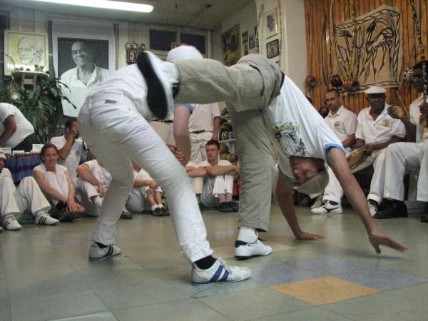
The best-known example of these disciplines is the dazzling Afro-Brazilian practice of capoeira, but Desch-Obi points out that related arts were practiced in the United States under the name of "knocking and kicking"; l'adja on the island of Martinique; and various other names in South America. Though they were—and remain—extremely popular practices in these areas, historians have traditionally glossed over their origins and significance.
"It's a very time-consuming methodology, in that conventional archival research on the topic is like searching for a needle in a haystack. References to the martial arts in archival records are rare—they do exist, but they are few and far between. I also have to spend a significant amount of time in the field, doing ethnographic participant-observation with living exponents of the arts."
Since his days as an undergraduate at Harvard, Desch-Obi has spent virtually every vacation—including summer, winter, and spring breaks—doing fieldwork and archival research, primarily in areas of Angola, Democratic Republic of Congo, Brazil, Cuba, and Martinique.
He consulted additional records in Portugal and France, among other European locales, while completing his doctoral degree at UCLA, and his dissertation work and most recent research form the basis of his book, Fighting for Honor.
He credits his interest in the subject to a lineage that includes some celebrated combatants in his own family. "African martial arts have fascinated me as long as I can remember," he says. "My first experience with martial arts was with mgba"—a style of wrestling practiced by the Igbo of eastern Nigeria, where his father's family originates—"and both my father and great-grandfather were famous fighters. For me, it's a labor of love."